
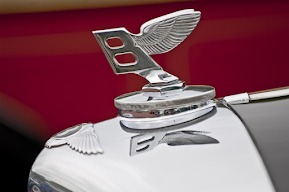
What this article is about
While reading up about the Facel Vega for my previous blog, I came across the Bentley Crest. It is a coach-built car designed by Pininfarina, the famous Italian design house and built-in collaboration with a French company called Facel Vega. This luxury coupe has a French-Italian connection and is a car that holds a lot of history behind it.
The car and its humble beginnings
The year is 1946 and most of Europe is coming out of a dark time, the World War II and Hitler’s work. Italy then led by Mussolini was a strong nation and had come under the watch of the league of nations and was sanctioned for their actions of invading Abyssinia in 1936. Italy’s friendship with Great Britain and France was cut off and they instead entered a pact with Nazi Germany on October 25th 1936, known as the Rome-Berlin Axis based on a speech given by Mussolini a week after signing the pact.
 |
| Axis Alliance (left Mussolini and right Hitler) |
What got other countries to later look at Italy under a microscope was their actions post the attack of Poland and what was the start of World War II on September 1, 1939. Italy initially remained neutral but upon the defeat of France on July 10th, 1940, they joined Germany as an ally.
The repercussions were faced unfortunately by many small design houses and coach builders from Italy. As things were slowly getting back in Europe, many countries refused to trade with former Nazi states like Germany and Italy. France was very strict with their ban on trade. Hence, when the Paris Auto show was held again on September 1946 cars from Germany and Italy were not allowed to be displayed at the Show.
 |
| Grand Palais, Paris, 1950's |
The ban hit the smaller coach builder such as Batista Pininfarina the most. The ban however did not crush Batista’s spirits as he along with his son Sergio drove from Italy to Paris in an Alfa Romeo and a Lancia and parked it right outside Grand Palais. The two cars got a lot of attention eventually forcing the event organizers to put Pininfarina on the list of undesirables for the following few motor shows. But Batista did not mind as he had received quite a few potential customers. Among the few curious customers was Jean Daninos the head of Facel- Métallon. Jean Daninos was the one who also offered him a lucrative deal just after the unfortunate factory fire of Pininfarina.
 |
| Battista Farina |
The First car: The Mark 4 Cresta 2 Facel-Métallon

 |
| 1951 Bentley MK VI Coupe Facel-Métallon in Milan |
Jean Daninos was an adventurous man and hence he decided to buy a rolling chassis of a MK 4 Cresta 2 and coach build a body around it. Post World War 2, Bentley and Rolls Royce had moved to new factories and the traditional hand building methods were not present. Only the few special order cars were coach built. Earlier Bentley’s used to house a smooth 6-cylinder engine right from the 30's. This engine was phased out for a bigger 4.5L Inline-6 L head engine that produced roughly 153HP.

The Bentley MK IV was introduced in 1946 and production went on till 1952, roughly 5000 samples were made. The Bentley Mark VI was the Rolls-Royce Silver Dawn’s competitor. Both cars are known to be the first few cars to have standardized bodies. Prior to this Bentley and Rolls-Royce would send the rolling chassis to a coach builder and they would custom build the bodies. The Bentley MK IV saw very few changes in its 6-year production, the only significant change being the engine being upgraded to a 4.9L from the 4.5L.
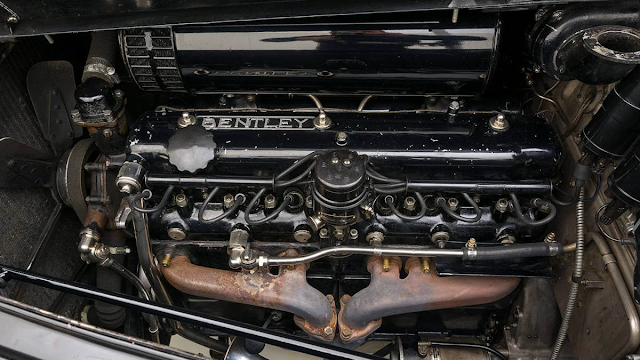 |
| The inline 6 cylinder |
Around 1000 Mark IV were sent to different coach builders, the two notable ones here are Pininfarina and Facel. Of the thousand sent, they were built as dropheads, sedans, and Coupes. The Facel- Métallon was a one-off created by Jean Daninos at Facel prior to creating his own line of cars known as the Facel Vega FV. The Bentley Cresta II to show case his capabilities managed to build only one car but kept re-painting it and sending it on Auto show circuits, he kept re-painting the car to give the impression that several were built.
The first Cresta to ever be built

Pininfarina had been vocal about designing an out-and-out performance Bentleys. As mentioned earlier, he could not directly display his cars as he was not allowed to the event by the organizers. However, Danino’s request for a sports coupe Bently to be built by Pininfarina would also help Pininfarina in a major way. A coachwork design ordered by a French customer would not be left out from exhibition at a future Paris Salon, this helped Pininfarina get many interested clients to place order at the 1948 Paris Salon.

 |
| Pininfarina Factory in Turin |
Jean Daninos arranged for a series production of the Cresta at Facel-Métallon, this decision made it easier for the people at Crewe as well as they offered to help with the redesigned radiator that had to fit into new body design. Bentley even delivered a chassis with the engine and a redesigned steering rack to better suit the coach bult requirements. Pininfarina even manufactured a one of one convertible in 1949.
The process of manufacturing the car
 |
| Sheet metal rolling at Pininfarina |
Three prototypes (one of them being chassis number B323CD) were built in the Pininfarina factory back in Turin and was sent to Facel-Métallon. At Facel the 3 prototypes were compared with the 10 odd samples built by Facel. A wider radiator grill was provided and looked different when compared to the standard Bentley radiator grill. Upon Bentleys request they had to modify the design of the grill.

One can also differentiate between the three prototypes built by Farina versus Facel’s cars through the appearance of the grill. Facel had to install another grill at the direct request of Bentley. H. J. Mulliner & Co. a British coach builder also found tweaks in the chassis delivered for the Cresta, the steering column was lower and there were a few other minor changes. The production went on up to 1950 in a separate workshop in Facel.

A very special car a one off was created for Mrs Danino. In 1951 the unique Cresta II achieved quite a feat of engineering with its low mounted engine and sleek coupe body, it was just so beautiful. The car also showcased the talents at Facel-Métallon and was a preface to the Facel Vega.
Conclusion
 |
| 1948 Bentley Mark VI by H.J. Mulliner |
This car is an important bridge between the pre-war Bentley Corniche and the post-war Bentley Continental. The smooth flowing lines made it look so elegant and has pretty much set the standard body lines that we look for in a luxury coupe till date. The step away from pre-war Bentley’s was best executed by Pininfarina along with Facel. Overall it was great learning about the struggles faced by Pininfarina and the reason behind what makes him such a legendary figure in the car world, and MK VI is just a stunning rare car that I hope to see in person someday.
 |
| Bentley MK VI drop head by Pininfarina only 1 exists |
Picture Resources
https://hymanltd.com/vehicles/6966-1951-bentley-cresta/
https://auta5p.eu/lang/en/katalog/auto.php?idf=Bentley-Mk-VI-Cresta-II-Facel-1442
https://pininfarina.it/en/heritage-designstory/#1990
Nice to know the history of Bentley. Well researched with quality content!
ReplyDeleteReally appreciate your reasearch!!! Kudos to your effort
ReplyDeleteThe information present here is just amazing
ReplyDeleteAnother Sooper blog loaded with information from the past 👍🏼 janardhan
ReplyDeleteGreat write up! Enjoyed reading about the history behind the cars and their design. Appreciate the research that’s gone in to the blog.
ReplyDeletePaulomi
A lot of research has been done in writing this blog.
ReplyDeleteAniruddha has given background information on pre & post war problems faced by designers and manufacturers of Bentley Cresta.
Quality images have been included
This is a fantastic and exhaustive blog for those who love vintage classic cars.